
If you work shifts, take tips, drive for apps, or book clients, your income may look different every week. A strong weekend can make the month feel easy. A slow stretch can leave rent and bills feeling close.
A useful way to budget with irregular income is to plan around a conservative income floor, not your average or your best month. Then give incoming money clear jobs with five savings “jars”: slow season, rent, tax, goal, and buffer.
These jars can be separate accounts, labeled savings buckets, or simply categories you track. The point is to know what each dollar is for before you spend it.
Start with your lowest typical month, not your average
An average can hide the squeeze. If you earned $2,200 one month and $4,000 the next, the average is $3,100, but that doesn’t mean $3,100 will be there when your bills are due.
Look at six to twelve months of take-home income. For a server, that means accounting for tip-outs and work costs. For a driver, subtract relevant fees and costs you track. For a salon worker, use the amount you keep after work expenses. Choose the lowest reasonably typical month as your starting point, rather than a one-off month when you were sick or unable to work.
The Consumer Financial Protection Bureau also recommends paying attention to cash-flow timing: when money arrives matters as much as what comes in over the month. Its guide to emergency savings has practical advice for setting aside money even when income changes.
Your first step: Write down your conservative monthly income floor and your essential bills. If the floor doesn’t cover essentials, that’s useful information, not a reason to pretend a high month is guaranteed.
Give each dollar a job with five jars
Use these five categories to keep current bills, taxes, and future needs from competing in one undifferentiated balance.

1. Rent jar: protect the next bills due
Start with housing and other essential obligations: rent, utilities, groceries, insurance, minimum debt payments, and transportation you need to work.
Set a target for the next rent payment and any bills due before your next reliable inflow. If your rent is $1,200 and you earn four times before it’s due, you might aim to set aside about $300 from each inflow. Adjust the amount to your actual schedule; income won’t always arrive in four equal parts.
This jar is for bills with a due date. It isn’t extra spending money just because the balance looks healthy today.
2. Tax jar: keep tax money separate from spendable money
If you’re self-employed or receive 1099 income, taxes generally aren’t withheld from each payment. Setting aside a portion as income arrives can help you avoid treating that money as available to spend.
The right amount depends on your total income, filing situation, expenses, and location. Don’t assume one percentage will fit everyone. Use a tax professional or a reliable estimate for your circumstances, and check the IRS guidance that applies to you.
If you also have W-2 tip income, your withholding may work differently. Keep records of both income types and ask a tax professional how to handle your situation. Night Shift’s tax guide for gig workers explains the basic idea of reserving money as you earn, but it isn’t a substitute for individual tax advice.
3. Goal jar: save for a cost you can see coming
Some expenses aren’t monthly, but they aren’t surprises either. Think vehicle maintenance, work supplies, insurance renewals, a license fee, or a trip you’ve planned.
Estimate the cost and when you’ll need it. If you need $600 for a car repair fund in six months, a simple target is $100 per month. If income varies, contribute when you can and review the timeline as you go.
You can also use this jar for a personal goal. Keep planned costs and wants clear in your notes so you know what you’re saving for.
4. Slow-season jar: prepare for predictable income dips
Some work follows a pattern: fewer shifts after a busy season, quieter weekends in certain months, or fewer clients during a regular lull. Use past earnings to identify those periods, then build this jar during stronger months.
For example, if you expect your income to fall by about $300 a month for three months, a $900 slow-season target could help cover that gap. Treat this as a planning estimate, not a promise that next season will match the last one.
5. Buffer jar: give the unexpected somewhere to come from
The slow-season jar is for a dip you can reasonably anticipate. The buffer jar is for something you couldn’t schedule: a tire replacement, a medical bill, or a week when work unexpectedly drops off.
There’s no single right target. Start with an amount that would make a common surprise easier to handle, then build from there. The CFPB notes that emergency savings goals depend on your circumstances and past expenses; even a small reserve can be a useful start.
Keep the buffer distinct from your rent and tax money. That way, an unexpected expense doesn’t quietly turn into a missed bill or a tax shortfall.
Example: make the plan work with uneven pay
Imagine your take-home income over six months was $2,300, $2,650, $2,900, $3,400, $2,500, and $3,100. If $2,300 was a typical low month, use that as your starting floor.
Suppose essential bills total $1,850. That leaves about $450 at the floor for taxes, planned costs, goals, and flexible spending. The exact split depends on your obligations, especially your tax estimate and upcoming bills.
In a $3,400 month, don’t immediately raise your regular spending to match. First cover essentials and your tax reserve. Then fill the goal and slow-season jars. Put remaining surplus toward your buffer or another priority.
In a $2,100 month, use your plan to see what needs attention early. If essentials exceed your income, you may need to draw from an appropriate reserve, adjust discretionary spending, or look for another way to cover the shortfall. The jars help you see the gap; they can’t make income or expenses disappear.
Make it easier to keep up between shifts
A notebook or spreadsheet can work well if you update it. A budgeting app can help you see balances and reminders in one place. If you’re looking for an irregular income budget app, choose one that lets you track what you actually take home and adjust categories when your income changes.
For tipped and gig workers, a useful routine is simple:
- Log what came in. Record the shift, tips, client payment, or platform income, plus relevant work costs.
- Set aside tax money. Use an estimate suited to your situation, not a universal guess.
- Fund your jars in priority order. Start with upcoming essentials, then planned needs and reserves.
- Review once a week. Check what’s due before your next expected income and adjust if the week is slower than planned.
Night Shift’s Shift Tracker and Goal Jars are designed for variable, tip-based income. The tracker records what you actually walked away with, and Goal Jars let you organize savings for taxes, bills, slow seasons, and personal goals. They’re virtual tracking buckets, not separate bank accounts, so your money isn’t moved to another bank account by the jars.
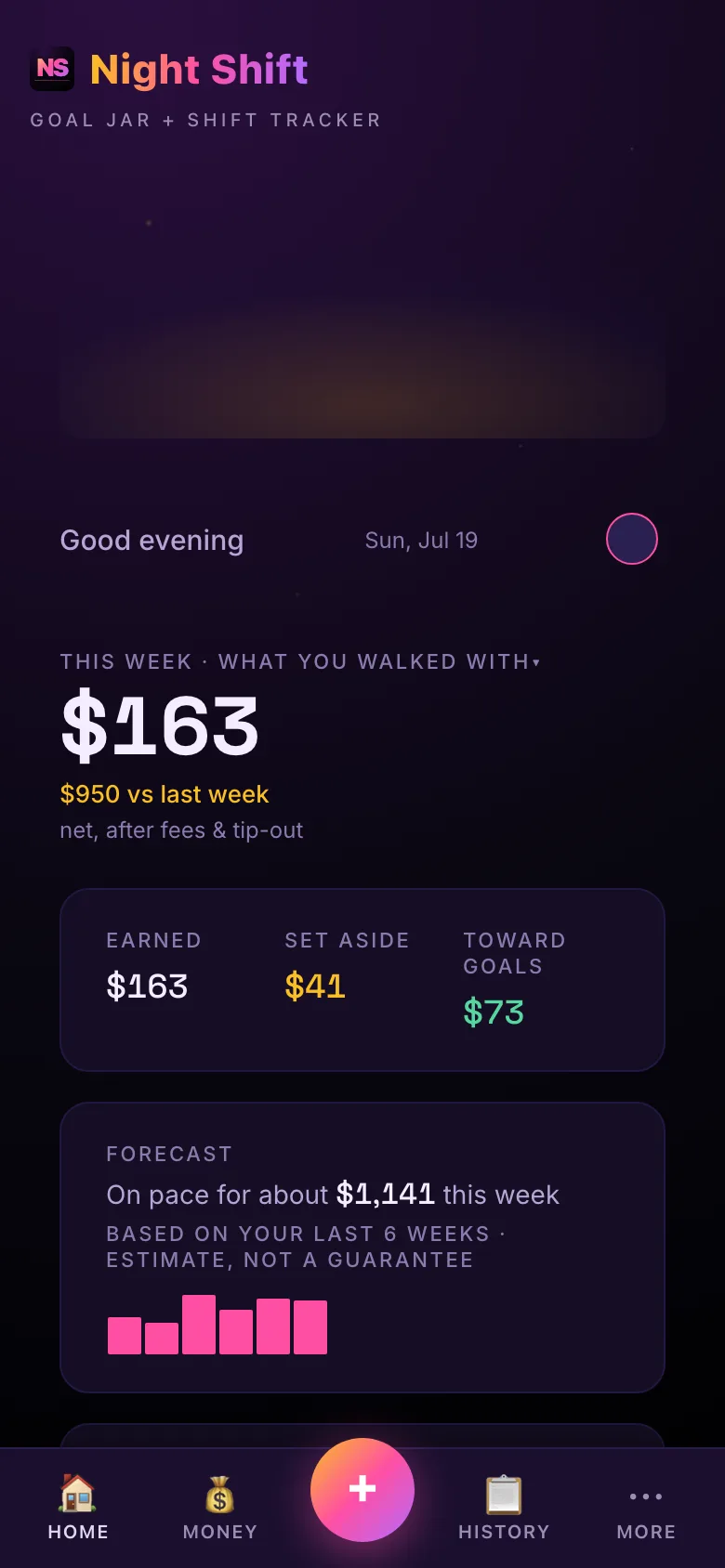
A forecast based on past shifts can be helpful context, but it’s still an estimate. Use your actual income and bill dates to make decisions.
Start small, then adjust the numbers
You don’t need five full jars funded before this system can help. Start with the rent due next, keep tax money separate if you need to reserve it, and choose one small savings target. Add the other jars as you get a clearer picture of your cash flow.
Review your income floor every few months, or when your work changes. A budget should reflect your current shifts, clients, and expenses, not lock you into last season’s numbers.

Want a simpler way to keep track? Explore Night Shift Goal Jars and see how they fit your routine. You can start a free trial; check the sign-up screen for your trial length and billing terms.
Track your tips. Build your reserve. Know where you stand.
Try Night Shift free for 30 daysNo charge until the trial ends. Cancel in two taps. English & Spanish.